

Reconstruction of the 41/42 building.

From prototype to industrialization and introduction of the new Training and Technology Centre.

Renovation of the 45 building including the museum, meeting rooms and cafeteria.
Commissioning of a fully automatic vibratory finishing system for medical technology.
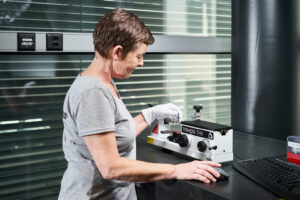
Installation of an air-conditioned measuring and test equipment monitoring system. Commissioning of a new cleaning plant and tool shop.
Certification for the manufacture of medical products according to ISO 13485.
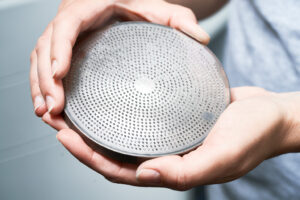
Creation of an in-house polissage department for watch screws.
Certification of the environmental management system according to ISO 14001.
The world's first multispindle MS18C from Index starts work. The use of multi-spindle machines is constantly being expanded. They allow a rational and more precise production of parts in only one operation.

New glass building with three bright, column-free and air-conditioned production halls. An almost identical second building and an underground car park with 130 spaces will follow in 2014.
Purchase and commissioning of the first multi-spindle machine, the Multideco 20/6 from Tornos.
The company name Gebrüder Laubscher und Cie. becomes Laubscher Präzision AG.
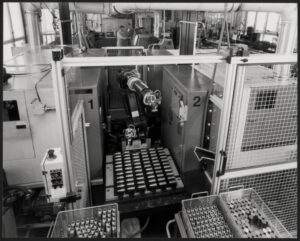
The first computer-controlled CNC machines are put into operation: Star VNC 20.
Introduction of a certified quality management system according to ISO 9002 and statistical process monitoring as one of the first industrial companies in Switzerland.
With the 125th anniversary, piecework wages are abolished.
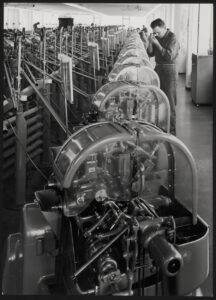
A new building on the valley side doubles the production area.
From the middle of the century the range of production techniques is expanded. Thanks to surface treatment and finishing, the value chain is extended.
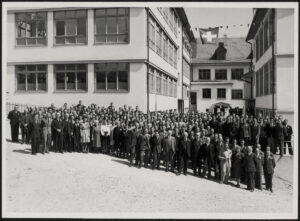
The company celebrates its 100th anniversary.
The company grows rapidly in five stages of construction. A company health insurance fund and a welfare foundation are created to provide social security for employees. Laubscher builds single and multi-family homes for its employees to counter the shortage of housing in Täuffelen.
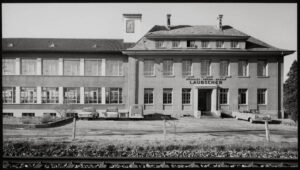
Business with gramophone needles runs smoothly. Laubscher opens a second factory in Murten for needle production.
Foundation of a stock corporation. The articles of incorporation stipulate that shares can only be acquired within the family.
A Russian inventor commissioned Laubscher to produce a new type of gramophone needle. The workforce now comprises almost 100 people.
Electricity enters the factory. The electricity flows from the newly built power plant in Hagneck, which Samuel Laubscher and his successors had been working for since the construction of the canal. Shortly afterwards, the company builds a telephone line from Biel to Täuffelen at its own expense.
The Laubscher brothers patent a lathe with automatic slotting machine. For the first time, a finished screw is produced in a single operation.
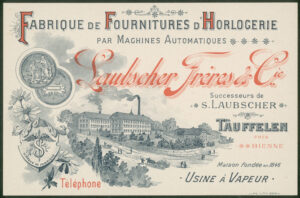
First mention of a steam engine
His five sons Alfred, Numa, Eduard, Adolf and Gottfried and his son-in-law Jakob Laubscher take over the company as a general partnership. Gottfried later leaves the company as a partner and founds his own company.
Together with the mechanic Tschopp, Samuel Laubscher develops the first automatic lathe.
Return to his homeland and construction of the first factory in Täuffelen.
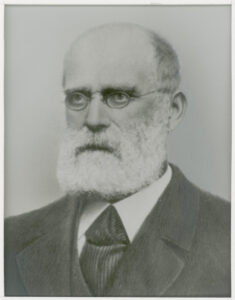
Samuel Laubscher founds a precision engineering workshop in Malleray in the Bernese Jura for the manufacture of watch screws.